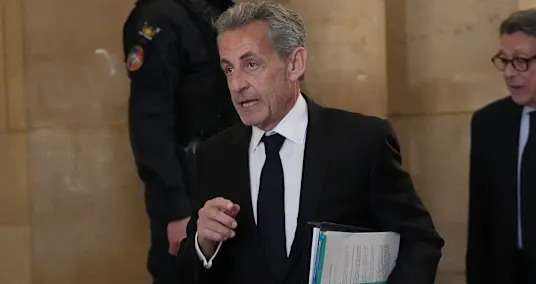
PARIS (AP) — France's former president Nicolas Sarkozy maintained his innocence on Tuesday, telling an appeal hearing in Paris that not a single cent from Libya helped fund his 2007 presidential campaign.
“I owe the truth to French people,” Sarkozy told a three-judges panel during a hearing in the case that lead him to spend 20 days in prison before being granted release pending appeal. “I’m innocent,” he said.
Sarkozy, 71, is challenging his conviction after being found guilty in September of “criminal conspiracy.” He was sentenced to five years in prison for his alleged part in a scheme to obtain funds from the government of late Libyan leader Moammar Gadhafi in exchange for political and diplomatic favors.
Sarkozy has repeatedly denied wrongdoing and claims the allegations were politically motivated.
Tuesday’s hearing focused on his role as a conservative presidential candidate and then president from 2007 to 2012. The 12-week appeal trial, which began last month, will reexamine all of the evidence and testimony related to him and nine co-defendants — including three former ministers.
Sarkozy stressed he championed Western military intervention in Libya in 2011 after Gadhafi’s regime violently cracked down on anti-government protesters, when Arab Spring pro-democracy protests swept the region.
“I took the initiative, France took the initiative. Why? Because Gadhafi had no hold over me — financially, politically, or personally,” Sarkozy said.
Gadhafi was killed by opposition fighters in October 2011, ending his four-decade rule of the North African country.
Sarkozy’s appeal hearing comes after families of French victims of a 1989 plane bombing expressed their distress last week over possible promises made to Gadhafi’s government as part of the alleged deal.
Libya in 2003 took responsibility for both the 1988 plane bombing over Lockerbie, in Scotland, and the bombing of UTA flight 772 over Niger the next year that killed 170 people, including 54 French nationals on board.
“I believe that such unspeakable suffering can only be answered with the truth,” Sarkozy said.
Financial prosecutors have accused Sarkozy of having promised to lift the arrest warrant targeting Gadhafi’s brother-in-law and intelligence chief Abdullah al-Senoussi, accused of masterminding the attacks, in exchange for alleged campaign financing.
“The truth is that I did not act in favor of Mr. Senoussi … who is in prison (in Libya) because he was arrested following the international action led by France,” Sarkozy said. “I never promised him anything.”
The trial at Paris appeals court is scheduled to last until June 3, with a verdict expected at a later date.
Sarkozy has faced multiple legal cases since leaving office. In November, the Court of Cassation — France’s top court — upheld his conviction for illegal campaign financing of his 2012 reelection bid, requiring him to spend six months under house arrest wearing an electronic ankle tag, a sentence that has yet to be implemented.
LATEST POSTS
- 1
 Medtronic has 'significant firepower' for multiple acquisitions, executives say
 - 2Dad issues urgent plea to find stem cell donor for his son
- 3'Israel has the right to continue its attacks,' Lebanese Foreign Minister announces
- 4Israel's haredi draft crisis: Court ruling and political stalemate reach breaking point
- 5Activists: Venezuela released just nine prisoners despite promise




- Met Gala 2026 will celebrate fashion as an 'embodied art form': A guide to the theme, dress code, cochairs and hosting committee of the starry event
- I’m a dad to an autistic child. Here’s how you can make the holidays easier for all of us.
- Sought-After Extravagance Ocean side Objections for a Lovely Escape
- 4 injured in shooting at North Carolina tree lighting ceremony
- UK forecast to face weaker growth and higher inflation from Iran war
- Ukraine proved this drone-killer works. Now, the West is giving it a shot.
- German official report: Teen social media ban faces legal hurdles
- Trump awarded 1st FIFA Peace Prize by Gianni Infantino at 2026 World Cup draw
- First stop, the Moon. Next stop, Mars? Why Nasa's mission matters