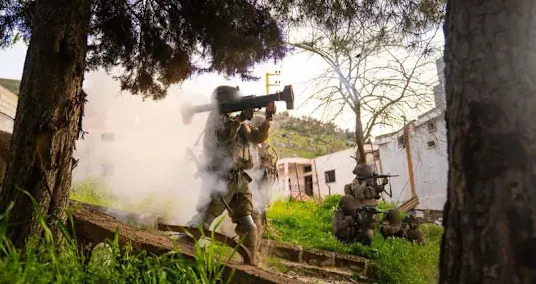
Source: Hezbollah using homes as hiding spots for reconnaissance, launchpads for anti-tank fire • More fighters detained after surrendering to Israeli soldiers
The IDF has begun demolishing homes in southern Lebanese villages located along the border with Israel, military sources said on Wednesday morning.
According to the sources, the houses targeted by the military were used by the Hezbollah terrorist group as bases to launch anti-tank fire and conduct reconnaissance of Israeli forces.
The razing was being carried out in accordance with orders issued by Defense Minister Israel Katz, who last week instructed the IDF to begin destroying homes and bridges south of the Litani River.
"We have ordered an acceleration in the destruction of Lebanese homes in contact-line villages to neutralize threats to Israeli communities, in accordance with the model of Beit Hanun and Rafah in Gaza," Katz said at the time, adding that the military will continue to allow residents of southern Lebanon to evacuate northward.
IDF captures Hezbollah terrorists, sources observe 'low morale' among fighters
Meanwhile, IDF divisions continued their ground incursion into southern Lebanon overnight on Wednesday, maneuvering deeper into Lebanese territory, a security sources said.
Several Hezbollah fighters were detained as prisoners of war after surrendering to Israeli forces in the past 24 hours, sources added, saying they were transferred over for interrogation.

IDF sources observed "low morale" among the terrorists who were captured, most from the capital Beirut. Other fighters were said to have managed to flee north of the Litani River.
Furthermore, the fighters were said to have employed heavy guerilla warfare, using the demolished homes as hiding spots between rounds of fire aimed at Israeli troops.
Last week, defense sources told The Jerusalem Post that Israel plans to keep “effective control” of southern Lebanon even for an indefinite period after the current war ends, presuming that Hezbollah will not yet have disarmed.
IDF kills over 40 Hezbollah terrorists in last 24 hours
Later on Thursday, the IDF said that it had killed over 40 Hezbollah terrorists and struck dozens of terror infrastructure sites through air, naval, and ground operations in Lebanon.
"In the past 24 hours, the Israeli Air Force struck dozens of headquarters, weapons storage facilities, launch sites, and anti-tank missile positions. The Israeli Navy also conducted a precise strike targeting a Hezbollah weapons storage facility in southern Lebanon," the military said.
Additionally, ground operations included an offensive from the 91st Division, which killed a Hezbollah terrorist cell in southern Lebanon, soldiers from the 36th Division engaging and killing three Hezbollah terrorists on motorcycles, the 146th Division dismantling over 180 terror infrastructure sites, and the 162nd Division locating numerous weapons.
Yonah Jeremy Bob contributed to this report.
LATEST POSTS
- 1
 Cuba fights to contain spread of mosquito-borne chikungunya virus
 - 2Israel violated ceasefire with Hezbollah more than 10,000 times, UNIFIL claims
- 3Private sector revives the climate disaster database Trump tried to squash
- 4Atorvastatin recall may affect hundreds of thousands of patients – and reflects FDA’s troubles inspecting medicines manufactured overseas
- 5Surprising links between autism, Alzheimer’s could change how we treat both



- NASA's giant moon rocket, in photos
- Bolsonaro briefly leaves Brazilian prison for medical tests after a fall from his bed
- Tablets: Upgrade Your Understanding Experience
- Brexit's Effect on New York's Ascent as a Main Monetary Center
- Solar storms have influenced our history – an environmental historian explains how they could also threaten our future
- Social Skylines d: A Survey of \Inside and out Social Experiences\ Language Learning Book
- Insurance warning signs in doctors’ offices might discourage patients from speaking openly about their health
- Journey through Pages: A Survey of \Plunging into Scholarly Universes\
- Why don’t humans have hair all over their bodies? A biologist explains our lack of fur