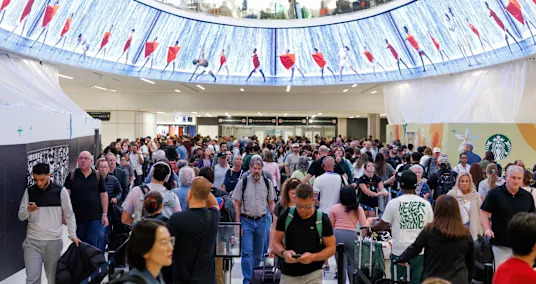
The massive wait times that have been plaguing airports across the United States are the result of an ongoing standoff in Congress that has absolutely nothing to do with air travel. The chaos that travelers have had to endure is a byproduct of a months-long disagreement between Democrats and Republicans over the Trump administration’s immigration policies.
Travel disruptions have put pressure on Congress to find a resolution, and there were some signs of optimism early this week that a path to a deal might finally be emerging. But that momentum appeared to stall as the two sides shifted to blaming the other for refusing to compromise and a renewed sense of frustration set in on Capitol Hill.
“I just want to go home,” one unnamed Republican senator told Politico.
Here’s a rundown of what's causing the airport disruptions, where negotiations stand and how the stalemate might possibly end.
How we got here
The root causes of the nationwide airport disruptions first emerged on the streets of Minneapolis more than two months ago. After federal immigration officers shot and killed two protesters during the Trump administration’s aggressive immigration campaign in the city, Democrats in Congress insisted that they would block any bill to fund the Department of Homeland Security (DHS) unless it included major reforms to how agencies like Immigration and Customs Enforcement (ICE) conduct their operations. Republicans have rejected nearly all of Democrats’ demands.
Democrats stuck to their pledge and allowed DHS to run out of money on Feb. 14. As a result, the department hasn’t had the funding it needs to pay its workforce, most of whom have been required to work throughout the shutdown because their jobs are considered essential for national security. There was close to zero progress toward a deal over the first month of the shutdown. That changed last week, when thousands of TSA agents began calling out of work each day. Without enough staff to handle the rush of travelers, security checkpoints quickly became bottlenecks that caused the longest wait times in history.
After a week of mounting pressure to end the chaos, Congress took its first meaningful steps toward a solution on Monday. A proposal was put forward that would fund the TSA and every other part of DHS — except for ICE’s enforcement and removal operations. Early in the week, there was some optimism on Capitol Hill that removing the biggest point of contention from the bill might be enough to bring the two sides together.
That optimism started to erode on Wednesday after Democratic leaders said they opposed the plan because it wouldn’t satisfy their demands for serious reforms. They sent the GOP a counteroffer on Wednesday that included what Senate Minority Leader Chuck Schumer called policy changes to “rein in ICE, with commonsense guardrails.”
Sen. John Thune, the top Republican in the Senate, rejected Democrats’ offer, accusing them of “going in circles” by asking for things that have “already been turned down.” On Thursday, Thune told reporters that he had sent Democrats what he described as his party’s “last and final” proposal.
“Let’s hope this gets it done,” he said.
President Trump has said he’s “not happy” with the GOP’s initial proposal, but hasn’t indicated whether he’d actively work to prevent it from passing.
Long lines at airports aren’t the only thing creating time pressure for lawmakers. Congress is scheduled to leave for a two-week recess on Friday. If no deal is reached by then and the recess is allowed to go on as planned, they wouldn’t be back in Washington, D.C., to consider new ways to end the shutdown until mid-April.
Can lawmakers agree on a deal?
Negotiations continued in the Senate on Thursday afternoon. Democrats have said that the latest GOP offer doesn’t meet their demands, but neither side has fully closed the door on the possibility of a compromise.
“At least we’re talking,” Sen. Angus King, an independent who caucuses with Democrats, said.
Republican Sen. John Kennedy also said Thursday that he’s considering proposing a standalone bill to fund the TSA and leave the rest of DHS shut down.
“I'm thinking about just going down to the floor and making a motion,” he told NBC News. “Just open, just pay TSA.”
Meanwhile, the White House is reportedly discussing alternative ways to blunt the impact of the shutdown, including potentially paying the TSA with funds that were allocated for other parts of the government.
Some Republicans are reportedly encouraging Trump to declare a national emergency, a step that would give him more flexibility to repurpose funds that were allocated to other parts of the government to pay the TSA, according to the Wall Street Journal.
LATEST POSTS
- 1
 Brazil judge orders government to add JBS subsidiary to 'dirty list' for slavery
 - 2Hypothermia claims newborn in Gaza and more babies are at risk, doctor says
- 3January’s full wolf supermoon and the Quadrantid meteor shower will start off the new year
- 4Nikki Glaser has been testing out Golden Globes jokes. There's one nobody wants to hear
- 5Virtual reality opens doors for older people to build closer connections in real life


- Scientists solve the mystery of 'impossible' merger of 'forbidden' black holes
- Instructions to Upgrade the Security Elements of Your Kona SUV
- Artemis 2 astronauts arrive at Kennedy Space Center ahead of NASA's historic launch around the moon
- Explainer-Why are hepatitis B vaccines given to newborns?
- Find Your Internal Culinary expert: Cooking Strategies and Recipes
- Figure out how to Guarantee Your Dental Embeds Endure forever
- Native Americans had dice and games of probability long before other cultures, study finds
- Why are NASA's Artemis astronauts wearing orange? What are they bringing to space? What to know about the preparation for their moon mission.
- Figure out How to Assess the Unwavering quality of SUVs for Seniors