April 1 (Reuters) - All three NASA astronauts on the Artemis II lunar mission are veterans of Earth-orbit science expeditions to the International Space Station, while the lone Canadian joining them on a voyage around the moon and back is a spaceflight rookie.
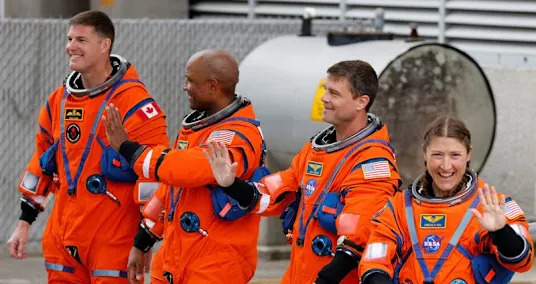
Here are some highlights from the careers of mission commander Reid Wiseman, pilot Victor Glover and mission specialist Christina Koch, all U.S. astronauts, and Canadian astronaut Jeremy Hansen, also a mission specialist.
MISSION COMMANDER REID WISEMAN
Wiseman, 50, logged 165 days aboard the International Space Station during a 2014 mission, flying to the orbiting platform aboard a Russian Soyuz spacecraft. A former U.S. Navy test pilot, he later served as NASA's chief astronaut before being selected to command Artemis II.
PILOT VICTOR GLOVER
Glover, 49, spent 168 days in orbit beginning in 2020 as pilot of NASA's Crew-1 flight, the first full-fledged ISS mission using SpaceX's Crew Dragon capsule to carry astronauts to the space station. Before joining NASA, he flew more than 40 aircraft during a U.S. Navy career that included combat deployments and test-pilot duties. A veteran of four spacewalks, he is the first Black astronaut ever to be sent on a lunar mission.
MISSION SPECIALIST CHRISTINA KOCH
Koch, 47, set a record in 2019 for the longest continuous spaceflight by a woman, spending 328 days aboard the ISS, and was part of NASA's first three all-female spacewalks. Trained as an electrical engineer and physicist, she previously worked as a NASA engineer and carried out extended research expeditions in Antarctica. She is the first woman to fly on a moon-bound mission.
MISSION SPECIALIST JEREMY HANSEN
Hansen, 50, a Royal Canadian Air Force colonel, is the first Canadian, and first non-U.S. citizen, sent on a lunar mission even as he makes his own first spaceflight. He was selected for Canada's astronaut corps in 2009, and his seat aboard Artemis II reflects a long-standing U.S.–Canadian partnership in human spaceflight, including Canada's contributions to robotics used aboard the ISS.
(Compiled by Joey Roulette in Cape Canaveral, Florida and Steve Gorman in Los Angeles; Editing by Jamie Freed)
LATEST POSTS
- 1
 Astonishing interstellar comet captured in new images by NASA Mars missions
 - 2The Significance of Health Projects in Senior Protection.
- 3Computerized Moderation: Tracking down Equilibrium in the Advanced Age
- 4Here's what can happen if you drive under the influence of pot
- 5The Century Coupe Could Be Toyota’s Most Ambitious Car Since the LFA



- Pfizer says patient dies after receiving hemophilia drug in trial
- International issues on the agenda as Frances's Macron visits China
- Germany expresses 'great concern' over Israel's new death penalty law
- Vote In favor of Your Favored Language Interpretation Administration
- All that You Really want to Be familiar with Dental Inserts Facilities
- Picking Childcare Administrations for Your Loved ones
- Iran begins cloud seeding to induce rain amid historic drought
- How to watch NASA's Artemis 2 astronauts launch to the moon on April 1
- How HIV/AIDS got its name − the words Americans used for the crisis were steeped in science, stigma and religious language